Brazoria County Property Tax Protest: Deadlines, Evidence & Expert Strategies for 2026

Every year, thousands of Brazoria County homeowners and business owners receive appraisal notices showing values that don’t reflect the real market or actual condition of their property. Filing a Brazoria County property tax protest is your legal right and when done correctly, it can meaningfully reduce what you owe. This guide covers the 2026 protest process, proven strategies, and practical advice for navigating the Brazoria County Appraisal Review Board.
Understanding the Brazoria County Appraisal System
The Brazoria County Appraisal District (BCAD) determines the market value of all taxable property in the county as of January 1st each year. This includes residential homes, land, commercial buildings, and business personal property. Taxing units school districts, the county, and cities then apply their rates to these values to calculate individual tax bills.
The Brazoria County Appraisal District uses mass appraisal techniques, assessing thousands of properties using statistical models rather than individual inspections. While efficient, this often results in inaccurate values for individual properties making the Brazoria County property tax protest process an important check on the system.
Learn how mass appraisal affects your home’s value: Texas Comptroller Property Value Study
Who Can File a Protest?
Any property owner in Brazoria County whose property appears on the appraisal roll has the right to file a protest. This includes:
• Homeowners (primary residences and investment properties)
• Commercial property owners
• Landowners agricultural, rural, and undeveloped tracts
• Business personal property owners
You may also authorize a licensed agent to file and represent you. If you own property through a trust, LLC, or other legal entity, an authorized representative may act on the entity’s behalf.
2026 Protest Deadlines and Important Dates
Staying on top of key dates is critical to a successful Brazoria County property tax protest. Here is what you need to know for 2026:
• January 1: Appraisal date; property values are set as of this date
• April: Brazoria County Appraisal District Mails Notices of Appraised Value to property owners
• May 15 (or 30 days after notice mailing, whichever is later): Protest filing deadline
• May through July: Informal meetings and Appraisal Review Board hearings conducted
• July through August: Appraisal Review Board decisions mailed to property owners
• August through September: Deadline for binding arbitration or SOAH appeal
If you miss the regular deadline, late protests are only accepted in very limited circumstances such as a clerical error in the appraisal records. Do not rely on exceptions. Always file by the deadline.
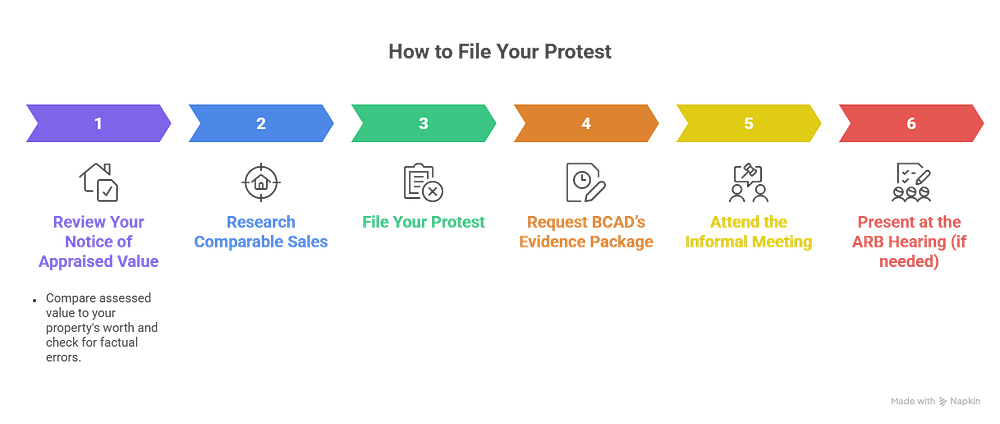
Step-by-Step: How to File Your Protest
Step 1: Review Your Notice of Appraised Value
When your notice arrives, compare the assessed value to what you believe your property is worth. Check for factual errors wrong square footage, incorrect bedroom count, or amenities you don’t actually have.
Step 2: Research Comparable Sales
Use tools like Zillow, HAR.com, or Redfin to identify recent sales of similar homes. Aim for at least 3–5 comparable sales within the past 12 months in your neighborhood.
Step 3: File Your Protest
Submit Form 50–132 via the BCAD’s online portal, by mail, or in person. You don’t need detailed evidence at this stage just file to preserve your protest rights.
Step 4: Request BCAD’s Evidence Package
At least 14 days before your hearing, request the evidence the Brazoria County Appraisal District plans to use. Reviewing it carefully helps you understand their reasoning and prepare a direct counter-argument.
Step 5: Attend the Informal Meeting
The Brazoria County Appraisal District will likely schedule an informal meeting with an appraiser before your formal Appraisal Review Board hearing. Many protesters reach a settlement at this stage. Come prepared with your comps and any property condition documentation.
Step 6: Present at the ARB Hearing (if needed)
If the informal meeting doesn’t produce a satisfactory result, appear before the Appraisal Review Board. Bring organized, printed evidence packets for each board member. Be brief, professional, and fact-focused.
Advanced Strategies That Get Results
Experienced protesters and tax professionals use strategies that go beyond simply pulling comps. Here are approaches that can strengthen your Brazoria County property tax protest:
The Equity (Unequal Appraisal) Argument
Texas Tax Code Section 41.43 allows you to protest on the grounds that your property is assessed unequally compared to similar properties even if your value is at or below market. You don’t need to prove market value, only that the Brazoria County Appraisal District assessed you inconsistently relative to your neighbors. This is one of the most powerful protest arguments available.
Using BCAD’s Own Data Against Them
The Brazoria County Appraisal District publishes appraisal data you can use to identify comparable properties that received lower valuations. Pull this data through their online search tool and present it as evidence of unequal treatment. The district’s own records become your best witness.
Challenging the Land Value Separately
Many protesters focus only on the improvement (structure) value and ignore the land component. If your land is valued higher than comparable lots nearby, challenge it separately your total assessed value is the sum of land plus improvements, and both are fair game.
Common Mistakes to Avoid
Even well-prepared protesters make avoidable errors that weaken their case. Here is what to watch out for:
• Filing late or missing the deadline entirely
• Failing to request Brazoria County Appraisal District evidence package in advance
• Using sales that are too old, too far away, or too dissimilar
• Being confrontational or emotional during the hearing
• Accepting an informal settlement without considering if the reduction is adequate
• Forgetting to apply for applicable exemptions before protesting
After the Hearing: Understanding Your Appeal Options
Once the Appraisal Review Board issues its final order, you have several options if you are not satisfied with the outcome:
• Binding Arbitration: Faster and lower-cost than court for properties valued at $5 million or less (residential) or $3 million or less (other property)
• State Office of Administrative Hearings (SOAH): An independent administrative hearing for certain eligible cases
• District Court: File suit in county district court requires an attorney but gives access to the full litigation process
Each option carries strict deadlines typically within 60 days of the Appraisal Review Board order. Act quickly if you intend to pursue further appeals.
For guidance on the arbitration process, visit: Texas Comptroller Arbitration Resources
The Long-Term Value of Filing Every Year
Many Brazoria County property owners file a Brazoria County property tax protest every single year and for good reason. Texas appraisal districts are under pressure to keep values close to market, meaning values can increase rapidly during rising markets. Annual protests signal to the Brazoria County Appraisal District that you are paying attention and will challenge inaccurate assessments.
Even in years when you don’t achieve a reduction, reviewing your property’s assessed value keeps you informed and ensures you’re not overpaying. In years when markets cool or your property experiences damage or depreciation, you will be well-positioned to make a compelling case.
Conclusion
Filing a Brazoria County property tax protest is one of the smartest financial moves a Texas property owner can make. The process is accessible, the law is on your side, and the potential savings are real. Don’t accept your appraisal notice at face value take action, build your case, and fight for a fair assessment every year.


Comments
Post a Comment